
Columbia County Arrest Log Window
The county's stand-in for a blotter is the ISOMS 72-hour current view. It rolls forward across three days of current entries. The moving clock means it is not a week-by-week calendar. It will not hold every arrest forever. The heading labels current inmates from the last 72 hours. Page depth changes as the roster changes.
That spread can catch an intake the 24 Hour Arrests window misses. Someone out of custody belongs in the released view. The portal promises no holiday exception and no fixed update schedule. It offers no archive depth.
Read Columbia Arrest Reports
Read official custody data first, then work outward. Note the time of each search. The intake timestamp anchors the booking event, while the release field and view heading show custody state. The top row is not a complete chronology of county police activity.
- Open the 72-hour current query and verify the heading and pagination.
- Match the full name carefully, then note intake time, city, arresting department, officer, charge, and bond fields.
- Open the 72-hour released query separately. Never combine it with the current count.
- Use the agency field as attribution for the displayed arrest, not as proof that the agency owns the jail record.
- For a final case outcome, check Search ARCourts or contact the appropriate clerk.
A Columbia County row may list Magnolia Police or the Sheriff's Office. Future entries can also name Waldo Police, Taylor Police, Arkansas State Police, or Southern Arkansas University Police. The arresting agency varies. The Sheriff still runs the county's detention record.
Columbia Arrest Log Fields
The multi-day result uses the same core booking fields as the live roster. Each field marks one point in the intake record. Names, charges, and timestamps fill the columns. The Sheriff's site posts no stand-alone booking-photo policy, though portal results can display images.
| Entry field | Meaning and limit |
|---|---|
| Name and descriptors | Name, age, and race/sex values tied to the entry; verify identity with care. |
| Intake date/time | The booking timestamp used to place the entry within the rolling window. |
| City | A city label from the record, not necessarily the alleged incident site. |
| Department and officer | The arresting agency and officer displayed by ISOMS. |
| Release date | A release event when populated; it does not close the court case. |
| Charges and bond | Charges and bond as booked, both subject to court change. |
| Photo | An observed official-interface image, not an invitation to make a gallery. |
Bond is a release condition set or changed through the legal process. It is not a fine. A booking charge can later be reduced, dismissed, or replaced by the filed court charge. Follow the docket to disposition, the recorded case outcome.
Weekend Columbia Arrest Coverage
No official source says Columbia County pauses ISOMS publication on weekends or holidays. The rolling 72-hour span helps across a weekend. It offers no fixed moment when every intake appears. Staff processing and source-system timing stay unpublished.
A Monday search should cover both current and released 72-hour queries. Someone booked and released in that span may drop off the current list. Save the retrieval time. Note the source intake time too. If a name is absent from both views, run the full current roster and ask the Sheriff's Office whether the record exists.
The official multi-day current source shows the wider arrest-log interface.
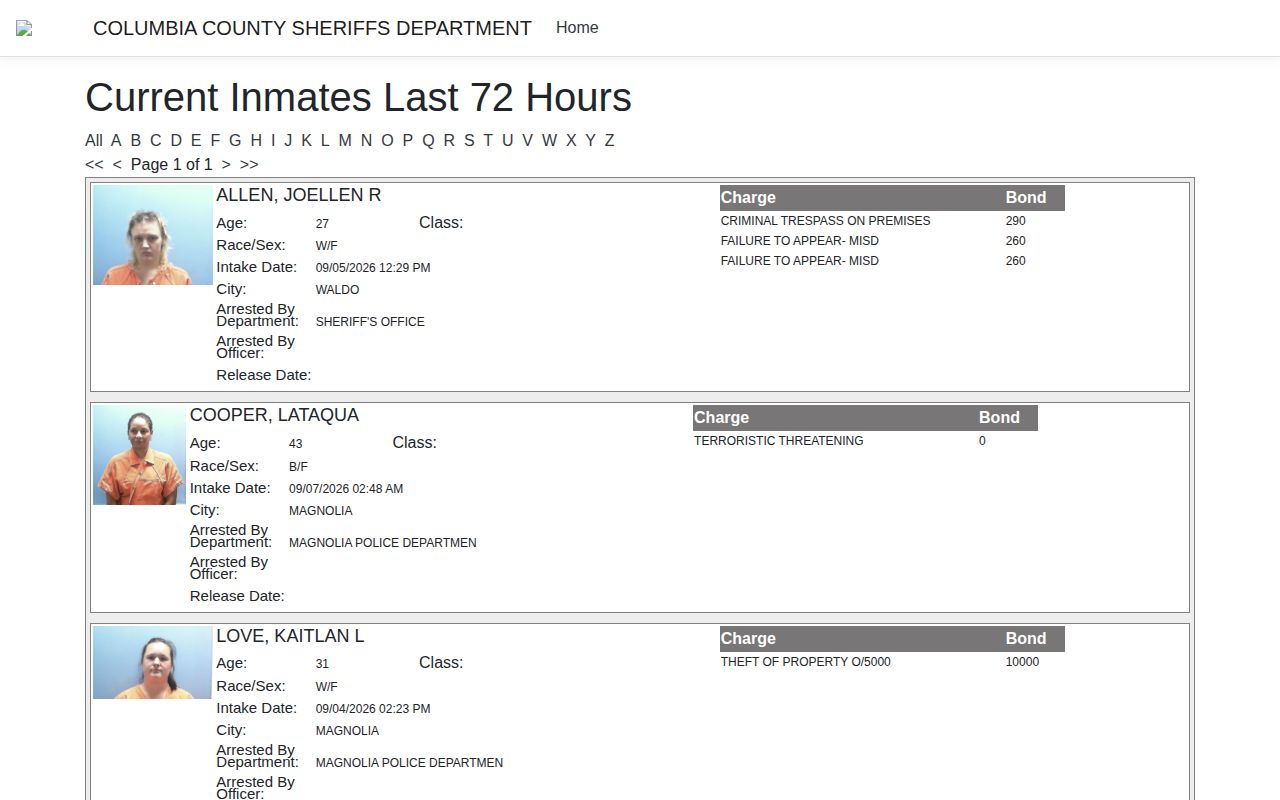
The capture is evidence of the interface at research time, not a permanent roster.
Columbia Arrest Log Archives
The live portal offers an all-released filter plus pagination. Some older release entries clearly persist there. The portal states no roll-off period, no completeness claim, and no archive guarantee. A row vanishing from a rolling screen was not erased for good. Deep pagination is not a full arrest history.
For an older intake sheet, release record, or booking image, call the Columbia County Sheriff's Office and ask for the records custodian. Name the person, the approximate booking date, and the record you want. Court filings go to the clerk. Very old transferred or microfilmed material may sit with the Arkansas State Archives. That office does not hold every modern jail photo.
Arkansas court-retention and sheriff-record rules differ by category, and they never say how long ISOMS displays a booking row. A focused records request beats guessing from pagination.
Current Versus Released Arrests
ISOMS supports all-current, 24-hour, 72-hour, and released queries. These are filters, not interchangeable lists. A name in the released view marks a release event. Do not call the person currently jailed without a fresh current-custody check, and use the official 72-hour released source to see that separate state.
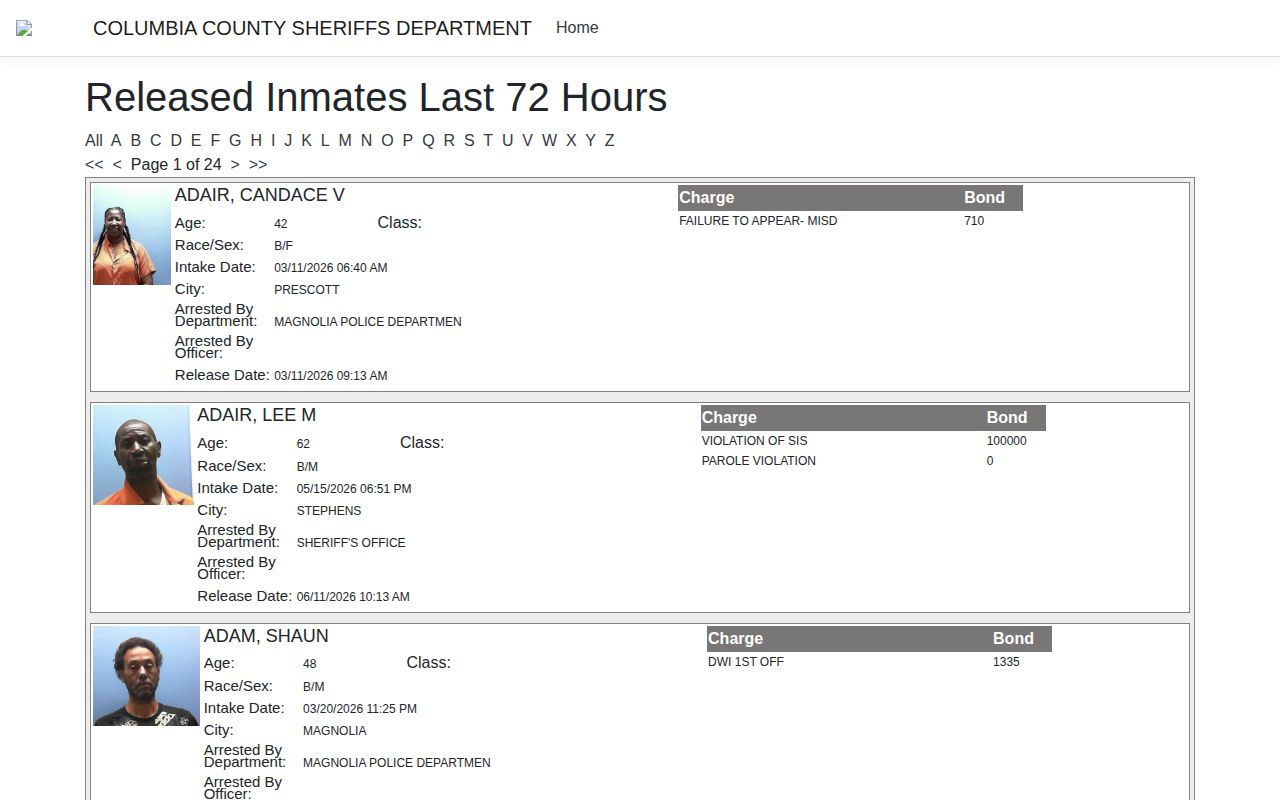
The released filter answers a different question from the current 72-hour log.
- Booking
- The jail intake process and resulting record.
- Release
- A departure from the reported custody state, not the end of a case.
- Disposition
- The court's recorded outcome for a charge or case.
- Detainer
- A request or legal hold that may affect release.
News Is Not the Arrest Log
News coverage adds color that a roster cannot. The Magnolia Reporter runs jail-booking stories on a steady cycle, and each one can help readers parse unfamiliar local terms. Still, its scope has limits the paper itself spells out. It skips some brief commitments, state inmates held for local court, and arrests made only on failure to appear. So it is not a stand-in for the full 72-hour ISOMS roster of Columbia County arrests.
For a closer look, the newspaper's public-records section gathers those booking items in one place. Posting follows the newsroom's own schedule. Nothing there carries a county guarantee. Use it as a second step after the official portal, and verify any individual's custody status through ISOMS. Republished regional pieces tend to spotlight a single incident rather than track recent arrests countywide, and the Magnolia Reporter's site is best treated as a companion channel, not the record itself.
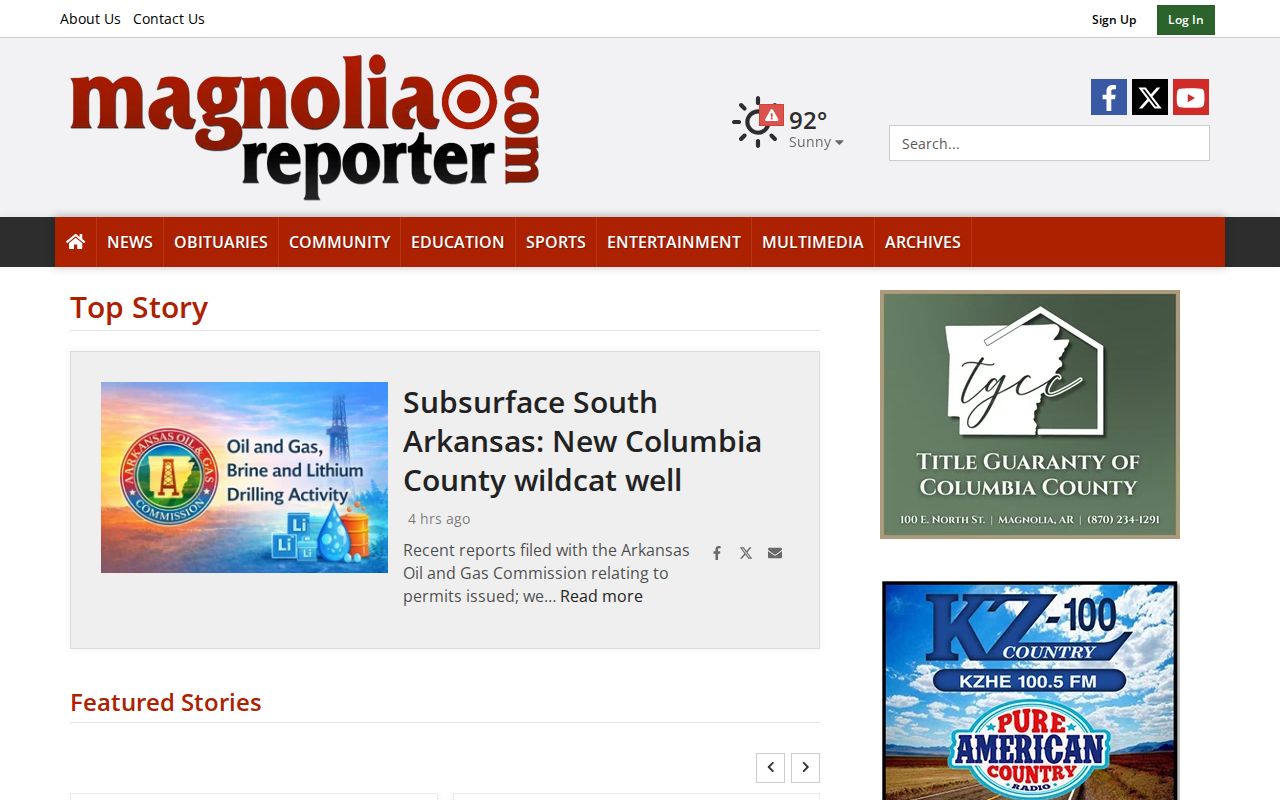
Treat the newsroom listing as a snapshot, not a jail roster. Aggregator sites add their own problems for Columbia County arrest searches: stale pages, duplicate entries, and copies that linger after the record changes. For booking facts, go straight to ISOMS, the official portal. News fills in context, and ARCourts shows where a case ended up.
Resolve Conflicting Arrest Reports
Time works differently in each channel. A Columbia County news story carries its publication date. ISOMS stamps an intake time and often a release time too. So never assume the article date equals the arrest time. The story has to say so outright. When two sources disagree, keep both versions rather than picking the louder one. Write down each source's date, its custody wording, and its label. Booking questions go to the Sheriff; docket questions go to the clerk. That habit stops one week of heavy coverage from inflating a countywide arrest count. It also keeps an outdated mirror of a Columbia County booking from being mistaken for current custody.
Public Record Search
Sponsored Results